How to efficiently machine shaped parts on CNC mill-turn machines?


Thin-walled parts feature a small footprint, light weight, a compact structure, and low material consumption.
Engineers widely use them in equipment and products across various mechanical manufacturing industries, provided they meet design performance requirements (i.e., technical specifications ensuring material strength and stiffness).
These industries include aerospace, precision machinery, testing instruments, molds, and the automotive sector.
Due to their complex internal stress distribution and tight geometric tolerances, thin-walled parts are highly sensitive during machining.
Even minor fluctuations in clamping forces and cutting forces can cause deformation, increasing machining difficulty.
This has long been a technical challenge in the machining industry.
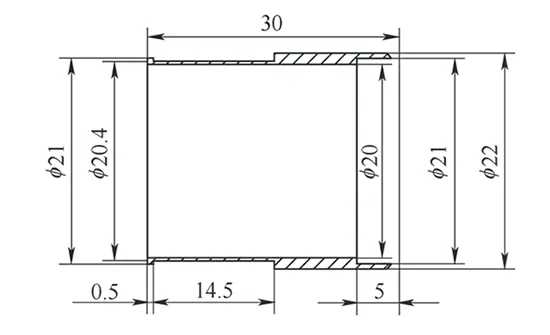
This paper focuses on the CNC machining process of thin-walled parts (see Figure 1) and, based on machining data, provides guidance for tool selection and process planning.
This part uses 304 stainless steel, which offers superior corrosion resistance and better resistance to intergranular corrosion than ordinary stainless steel.
It has a tensile strength of 620 MPa, a yield strength of 310 MPa, and an elongation of 30%.
This material consists of 0.07% C, 1% Si, 2% Mn, 0.03% S, 0.035% P, 17%–19% Cr, and 8%–11% Ni.
Since the carbon content is <0.08%, reducing work hardening during machining can decrease cutting forces by approximately 10%–15%, effectively minimizing deformation during processing.
The absence of Ti in this material reduces adhesion to cutting tools during machining and prevents the formation of TiC, thereby extending tool life.
To improve the product’s machinability, operators perform solution treatment on raw materials or rough-machined parts, depending on the component size.
Low-Temperature Solution Treatment: Temperatures are set between 800°C and 950°C. During machining, this increases cutting forces, leading to tool sticking and reduced tool life.
Standard solution treatment temperatures range from 1050°C to 1100°C.
This treatment improves ductility by 30% to 40%, eliminates over 90% of residual stress, and reduces stress-induced deformation of the workpiece during machining.
During high-temperature solution treatment, exceeding the recommended temperature by more than 50°C will cause grain coarsening.
This results in a 15%–20% decrease in yield strength and an increased risk of cracking during machining.
After solution treatment, the microstructure of 304 stainless steel becomes a single-phase austenite.
This significantly improves machinability, reduces tool wear, enhances ductility, and prevents chipping during intermittent cutting.
This part is a thin-walled, irregularly shaped component with a minimum wall thickness of just 0.2 mm on one side.
The coaxiality between the inner bore and the outer diameter is ϕ0.01 mm, and the cylindricity of the inner bore must be ≤0.01 mm.
Given these extremely tight geometric tolerances, the choice of cutting tools during machining has a significant impact on the part’s dimensional accuracy.
For roughing the outer contour, use a WNMG080404-HA insert mounted on an MWLNR2020K08 tool holder.
The insert material is PC9030, a specialized insert for stainless steel.
This insert features a small tip radius, which reduces tool wear during machining.
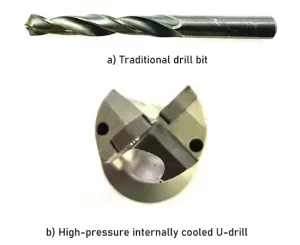
For roughing internal bores, use a 19 mm high-pressure internal-cooling U-drill instead of conventional drills to improve machining efficiency.
With traditional drills, the internal bore cannot be adequately cooled during machining, which can easily cause tool burning and result in secondary hardening of the material.
In contrast, the high-pressure internal cooling U-drill ensures sufficient cooling of the internal bore during machining.
It effectively prevents tool burning and keeps cutting temperatures within a controllable range.
This helps prevent secondary hardening of the workpiece.
A comparison between traditional drills and high-pressure internal cooling U-drills is shown in Figure 2.
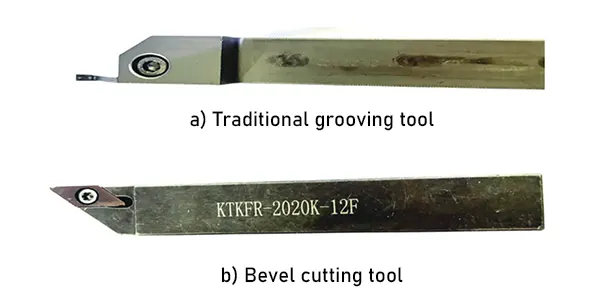
For the grooving cutter, select T K F 1 2R1 0 0 – S 1 6R inserts paired with a KTKFR2020K12F tool body; the inserts should be helical-cut.
Conventional grooving cutters perform radial machining, which can easily cause deformation of the product’s internal bore during grooving.
Oblique-cut inserts generate less cutting stress than traditional straight-cut cutters, thereby reducing part deformation.
A comparison between conventional grooving cutters and oblique-cut inserts is shown in Figure 3.
For external cylindrical finishing, select a VNGG160402R insert mounted on an MVGNR2020K16 tool holder.
This tool features a 0.2 mm tip radius, a 95° main rake angle, and a 50° secondary rake angle, resulting in minimal interference during machining and enabling the machining of most external dimensions.
Different cutting tools have a significant impact on product deformation.
For finishing operations, select tools with high sharpness, a small tip radius, and high wear resistance.
When machining internal bores, it is important to prevent thermal deformation from affecting part dimensions.
In addition to requiring tools with high sharpness and wear resistance, adequate cooling is necessary.
Whenever possible, select tools with high-pressure internal cooling.
Due to their thin outer walls, low strength, poor rigidity, and susceptibility to deformation, thin-walled parts are prone to thermal deformation or elongation during machining.
To ensure machining accuracy, it is necessary to further refine the production process and optimize machining techniques.
The machining strategy and the sequencing of toolpaths significantly affect product dimensions and deformation.
Before final finishing, residual stresses should be fully relieved, and finishing allowances should be minimized to prevent deformation after cutting.
The machining process is illustrated in Figure 4.
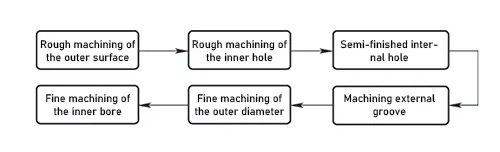
The improved process plan is described below.
1) Perform solution treatment on 23 mm diameter 304 stainless steel bar stock.
2) Select a WNMG 080404-HA insert mounted on an MWL NR2020K08 toolholder for rough machining of the outer contour, leaving an allowance for finish turning (spindle speed 100 rpm, maximum spindle speed 2500 rpm).
During machining, ensure consistency in the allowance and minimize it as much as possible without compromising the finish machining.
3) Use a 19 mm U-drill with high-pressure internal cooling to drill the bore, leaving a 0.5 mm allowance on one side (spindle speed 100 rpm, spindle limit 1500 rpm).
This ensures better cooling of the bore during machining and effectively prevents secondary hardening caused by cutting overheating.
4) Use a CCMT060204 CNC insert with a 12M-SCLCR06 internal coolant tool holder for semi-finishing the internal bore, with a single-side allowance of 0.02 mm (spindle speed 100 rpm, spindle speed limited to 2000 r/min).
The stock allowance for semi-finishing is particularly critical; excessive allowance may cause deformation during finishing.
5) Select TKF12R200-S inserts paired with KTKFR2020JX12 tool holders for grooving from the large-diameter end, with a single-side allowance of 0.02 mm (spindle speed 80 rpm, spindle speed limit 1500 rpm).
Pay attention to the cutting direction during machining; the workpiece can maintain machining strength during cutting.
6) Use a VNGG160402R insert with an MVGNR2020K16 tool holder to finish the flat end face to the finished dimensions.
Spindle speed: 80 rpm; maximum spindle speed: 1500 rpm.
Pay attention to the sharpness of the insert during machining to minimize workpiece deformation.
7) Use TKF12R100-S16R inserts with a KTKFR2020K12F tool holder to clear the root at ϕ20.4 mm (spindle speed 80 rpm, spindle speed limit 1500 rpm).
Pay attention to the tool mark at the root.
8) Select TPGH110302L inserts paired with an EC12M-STUPR11 internal coolant toolholder to finish-turn the bore to the finished dimensions (spindle speed 80 rpm, spindle speed limit 1500 rpm).
During machining, ensure the inserts are sharp to minimize workpiece deformation.
9) Select TKF12R100-S inserts mounted on a KTKFR2020JX12 tool holder to cut the total length to 30 mm (spindle speed 80 rpm, spindle speed limit 1500 rpm).
During cutting, ensure the workpiece does not fall; place sufficient cushioning material in the catcher to prevent deformation or damage if the workpiece falls.
The critical dimension data for the original process plan are shown in Table 1, while those for the improved process plan are shown in Table 2.
A comparison of the machining data in Tables 1 and 2 reveals that the original process plan resulted in significant deformation during machining, which affected the part’s cylindricity and concentricity.
Consequently, the cylindricity of the 20 mm inner bore and the 20.4 mm outer circle failed to meet the technical requirements specified in the drawings.
Due to machining deformation, the coaxiality of the two circles is also compromised, resulting in the product’s coaxiality failing to meet the technical requirements specified in the drawings.
The improved process plan can meet the machining requirements for the part, and the consistency of the part’s positioning tolerances is excellent.
| No. | φ20 (+0.01/0) | φ20.4 (+0.01/0) | φ20 Cylindricity | φ20.4 Cylindricity | Coaxiality of φ20.4 to φ20 |
|---|---|---|---|---|---|
| 1 | φ20.0091 | φ20.4083 | 0.0091 | 0.0121 | φ0.0113 |
| 2 | φ20.011 | φ20.4015 | 0.0055 | 0.0068 | φ0.0054 |
| 3 | φ20.0031 | φ20.4074 | 0.0132 | 0.0143 | φ0.0142 |
| 4 | φ20.0072 | φ20.4063 | 0.0152 | 0.0162 | φ0.0143 |
| 5 | φ20.0056 | φ20.4078 | 0.0142 | 0.0135 | φ0.0148 |
Table 1: Key Dimension Data of Original Process Plan (Unit: mm)
| No. | φ20 (+0.01/0) | φ20.4 (+0.01/0) | φ20 Cylindricity | φ20.4 Cylindricity | Coaxiality of φ20.4 to φ20 |
|---|---|---|---|---|---|
| 1 | φ20.0021 | φ20.4007 | 0.0032 | 0.0041 | φ0.0027 |
| 2 | φ20.0023 | φ20.4009 | 0.0031 | 0.0037 | φ0.0023 |
| 3 | φ20.0027 | φ20.4012 | 0.0027 | 0.0035 | φ0.0036 |
| 4 | φ20.0022 | φ20.4011 | 0.0035 | 0.0033 | φ0.0026 |
| 5 | φ20.0026 | φ20.4006 | 0.0033 | 0.0042 | φ0.0035 |
Table 2: Key Dimension Data of Improved Process Plan (Unit: mm)
1) Since the heat treatment temperature of the material has a significant impact on both the machined product and the service life of the cutting tools, careful control is essential.
It is recommended that the optimal temperature for solution treatment of stainless steel be set between 1050 and 1100°C.
2) Different cutting tools have a significant impact on the amount of deformation in the product; therefore, internally cooled cutting tools with high sharpness should be selected.
3) The improved process plan effectively ensures compliance with the product’s technical requirements and can serve as a reference for thin-walled parts with wall thicknesses of 0.15–0.5 mm.
4) Although thin-walled parts have low rigidity and strength, it is possible to ensure that product accuracy meets the technical requirements specified in the drawings by optimizing the machining process and toolpaths.